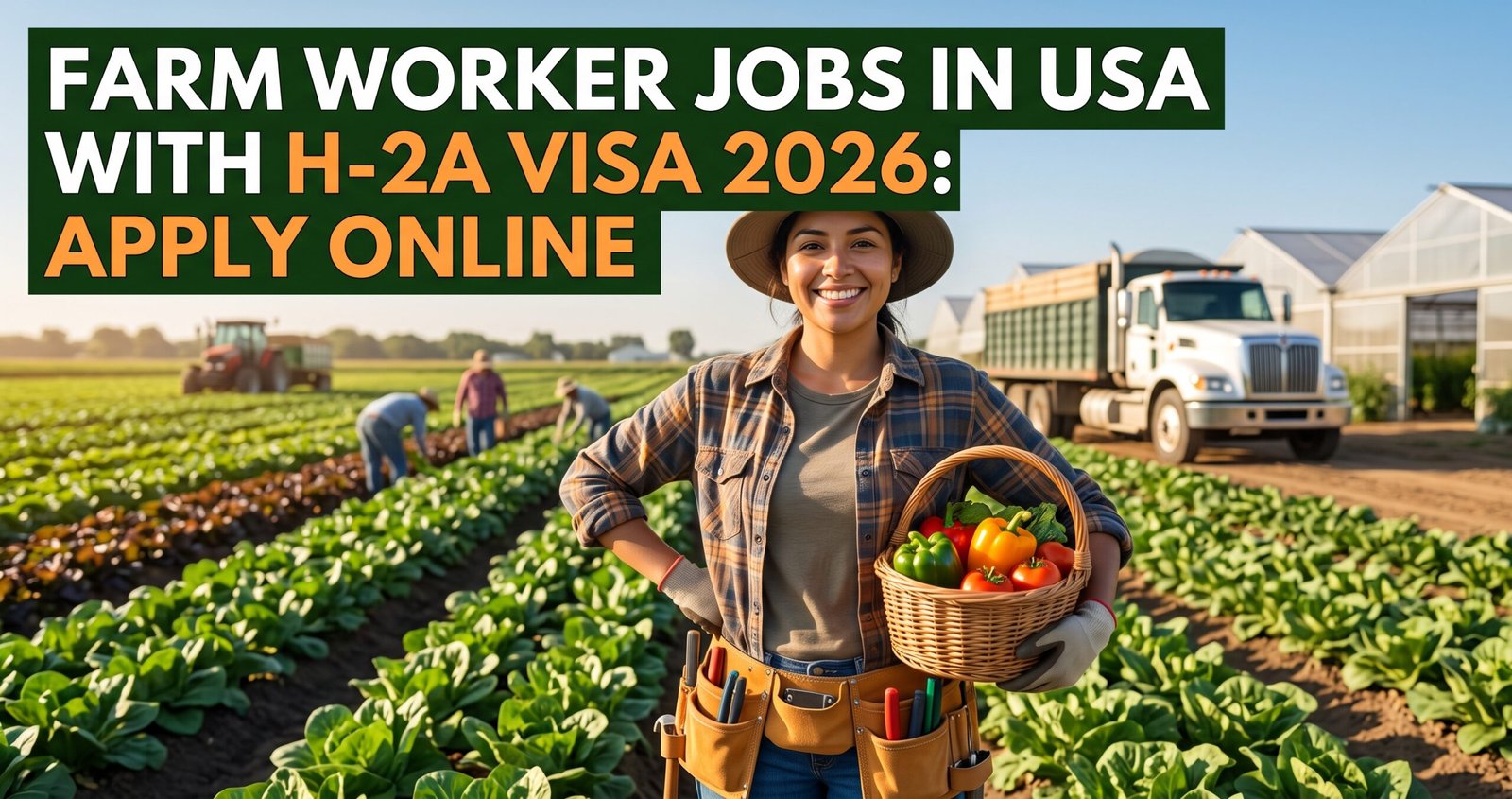
Farm Worker Jobs In USA with H-2A Visa 2026: Apply Online
Seasonal labor is a vital component for many agricultural operations in the United States, supplying the workforce needed to plant, grow and pick crops, and deliver them to the nation and the world. The H-2A Temporary Agricultural Worker Visa Program is America’s premier and most reliable immigration channel for foreign guests looking to seek legal, regulated, and temporary employment in the agricultural industry. However, it can become tedious to use foreign job sites, apply for positions listed on the government website or fill out all the consular forms, particularly when unscrupulous recruiters or shady agencies pose inappropriate promises.
This extensive guide explains the process of acquiring an H-2A farm worker visa altogether. You will learn how the H-2A visa system works, how to find verified jobs directly from the U.S. Department of Labor (DOL) Job Service Center database, what are the requirements for applying for an H-2A visa and what do you have to do to avoid getting ripped-off with an expensive recruitment scam. If you’ve been harvesting for years, if you’re a heavy harvesting farm machine operator, or if you’re just looking into harvesting this season in the U.S. for the first time, this walk through gets you exactly what you need to know for a safe, legal harvest.
Overview of the H-2A Visa Program in 2026
H-2A Visa is a category of a non-immigrant visa issued by the U.S. Federal Government that allows a U.S. agricultural employer to authorize the entry of foreign nationals into the United States for temporary or seasonal agricultural work if there is projected to be insufficient domestic workers to do the job.
The H-2A program is neither capped by a statutory cap nor based on any lottery system, in contrast to general employment programs or employment-based green cards. The Department of Labor can certify when the border is open to an agribusiness or U.S. farm with a legitimate, temporary labor deficiency and it can be proven that there are inadequate numbers of U.S. workers capable of doing that work.
Program is indelibly linked with the natural agricultural cycles. These dates are usually three to ten months and they’re based on specific seasons; spring planting, summer maintenance and autumn harvesting. The H-2A visa is a temporary visa, which may be extended in increments of time up to a total of three years of uninterrupted H-2A stay (or the maximum time allowed for that specific visa category), after which period the worker must leave the United States for at least three months to renew his visa for further time in the U.S. on H-2A status.
Key Highlights & Fast Facts
| Category | Policy / Program Detail |
| Annual Visa Cap | No yearly quota/numerical limit (uncapped) |
| Contract Duration | Typically 3–10 months (up to 3 years max with allowances) |
| Application Fees | $0 to the worker (Employers are officially barred from arraigning recruitment fees) |
| Housing Mandate | Providing at no cost to workers incompetent to return home daily |
| Travel Reimbursement | Inbound/outbound transportation & daily meals reimbursed below federal law |
| Wage Standard | Highest of: AEWR, statutory least possible wage, or normal local rate |
| Primary Portal | SeasonalJobs.dol.gov (Official public archive) |
Understanding H-2A Worker Rights & Employer Obligations
Implementing H-2A strictly regulated by the U.S. Department of Labor’s Wage and Hour Division (WHD) and the Office of Foreign Labor Certification (OFLC). Federal regulations set strict standards to prevent national workers from being undercut and to stop the exploitation of foreign workers:
The Adverse Effect Wage Rate (AEWR)
Employers are not allowed to establish wages arbitrarily in relation to H-2A workers. They must pay the federally calculated rate known as the Adverse Effect Wage Rate (AEWR), which is established on a state-by-state basis based on the agricultural labor surveys. However, should the federal or State minimum wage, or the negotiated prevailing wage be higher than the AEWR, the employer will have to pay that wage. There are no overtime laws that designate the base hourly wage that includes overtime hours as applicable in some states.
The Three-Fourths Guarantee (3/4 Rule)
Federal labor laws require the employer to ensure that the worker be given a full number of work days (equal to or greater than 75% of the work days specified in the original job order). Employer must pay the worker for the expressly required 75% of total number of hours in the contract even if reduction in hours was because of weather conditions, crop failure, or operational delay.
Free Housing and Sanitation Standards
Case in point: If the worker does not have a primary residence in the vicinity of the workplace within the reasonable commuting distance ( virtually all foreign H-2A workers would not qualify for this exception), the employer is required to furnish housing at no cost to the worker. The housing is required to undergo the rigorous safety checks, sanitary assessments and structure examinations by local and state health agencies before workers arrive. Accommodations shall include adequate cooking facilities, or shall provide the employee one 3-meal delivery each day, at a federally-approved, reasonable cost.
Transportation and Subsistence Coverage
The employer must make arrangements or pay a reasonable trip to get to the place of work rounded the 50% of the time the contract is scheduled to be completed or reimburse cost of the reasonable travel to the work place (including bus/flight expenses and meal stipends). If the worker has carried out the entire period of contract, the employer must also cover his/her expenses for traveling back to the country they are from. Furthermore, the employer(s) will provide complimentary day transportation from the approved housing units to the farm worksite.
Types of Farm Worker Positions Available
Agriculture is a various industry demanding varied physical skills, specialized mechanical skills, and animal husbandry information. H-2A job orders fall into some primary classifications:
Crop Harvesting and Hand Cultivation
- Key Responsibilities: Selecting delicate fruits (apples, berries, citrus, cherries), preparing, grading, sorting, container, and field pruning.
- Requirements: Physical stamina, heat tolerance, skill to lift 30–50 lbs constantly, and dexterity.
- Key Regions: California, Washington, Florida, North Carolina, Michigan.
Agricultural Equipment and Tractor Operators
- Key Responsibilities: Effective modern GPS-guided tractors, combine gatherers, irrigation pumps, sprinklers, and performing standard mechanical conservation.
- Requirements: Accepted prior experience effective heavy farm machinery, valid driver’s license, and straightforward troubleshooting abilities.
- Key Regions: Kansas, Iowa, Nebraska, North Dakota, Texas, Minnesota.
Livestock and Animal Care
- Key Responsibilities: Serving, breeding, observing herd health, extracting dairy cattle, assisting in births, cropping, and maintaining fence outsides.
- Requirements: Experience management cattle, swine, poultry, or sheep; well-being working in diverse weather situations.
- Key Regions: Texas, Wisconsin, Idaho, Wyoming, Colorado.
Greenhouse, Nursery, and Specialty Horticulture
- Key Responsibilities: Broadcasting ornamental plants, attaching seedlings, management drip irrigation systems, preserving, and preparing deliveries for wholesale insides.
- Requirements: Attention to detail, basic accepting of plant health, and conservatory climate controls.
- Key Regions: Oregon, Ohio, Pennsylvania, New Jersey.
Eligibility Criteria for H-2A Applicants
You and your potential employer must meet certain immigration criteria in order to be eligible for an H-2A position on the farm workers:
Eligible Country Citizenship
The number of countries that nationals are eligible to participate in the program are published annually by the Department of Homeland Security (DHS). H-2A visas can easily be granted to citizens from more than 85 designated countries, such as Mexico, Jamaica, South Africa, Guatemala, Honduras, Colombia, the Philippines and others. Non-designated countries nationals will only be eligible to participate if the employer files a petition at USCIS and is able to provide proof that there is specific national interest justification.
Valid Passport and Non-Immigrant Intent
Applicants must have a valid passport that is valid for at least six months after they will be in the United States; and also be able to convince the consular officer at the visa interview that they have strong family, social or economic ties to their home country, and that they will return once the agricultural contract has terminated.
Job Capability and Physical Fitness
The age of the applicant should not be less than 18 years and are physically able to do the job as mentioned in official job order. There are many jobs general harvesting jobs that do not need any credential as a part of their training, although equipment-specific jobs may require letters of reference or a credential from a program demonstrating skill.
Step-by-Step Guide: How to Apply for H-2A Farm Jobs Online
An H-2A visa is obtained through a coordinated process between the person who wants to bring in the foreign worker, the U.S. government, and the foreign worker. Getting a visa isn’t a process you can go through on your own, but it requires a job offer from the United States and an approval letter from an employment petition
Step 1: Search the Official DOL Database
SeasonalJobs.dol.gov is an open registry of U.S. Department of Labor certified agricultural job orders throughout the country.
- Visit SeasonalJobs.dol.gov.
- Filter by industry (Agriculture), a specific state, crop type or start date is required.
- Make sure you read the job listing thoroughly, and check the wage rate, housing and required hours per week along with the job duties.
Step 2: Contact the Employer or Certified Placement Agent
each job order posted on SeasonalJobs.dol.gov.
- Check the email address, phone number and even the recruitment agency website provided.
- Results: Send in your resume/CV outlining your resume or experience with agricultural equipment, contact information and agricultural skills.
- In a foreign labor recruiting program, check the foreign labor firm is in direct contact with and a direct agent for the U.S. employer, and will not require placement fees.
Step 3: Receive an Official Job Offer and Work Contract
If an employer chooses you, he or she will offer an Employment Contract in accordance with the guidelines approved by the Form ETA-790 / ETA-790A. This document outlines:
- Employment start and end dates for the job order.
- Hourly wage, piece-rate,
- Deductions (if applicable – for voluntary items).
- Home and transportation accommodations.
Step 4: Employer Secures Labor Certification and USCIS Petition
Before you go to the Embassy, you have to have the employer do two requisite filings:
- Form ETA-9142A: Prepare and file for Temporary Agricultural Labor Certification (ETA-9142A) with DOL Office of Foreign Labor Certification.
- Form I-129: File I-129 Petition for a Nonimmigrant Worker with U.S. Citizenship and Immigration Services (USCIS).
- USCIS then grants an approval notice (Form I-797B) that will provide you with a receipt number you will need for your consular visa application.
Step 5: Complete Form DS-160 and Pay Consular Fees
Using the Form I-797 receipt number given by your employer:
- Go to the website of Consular Electronic Application Center (CEAC).
- Fill out the Fact Form DS-160 (Online Nonimmigrant Visa Application) correctly.
- Submit an up-to-date, acceptable digital passport photo.
- Print DS-160 confirmation page containing confirmation barcode.
- Submit the MRV visa application Processing fee (MRV processing fee are to be paid by your employer and it is a legal requirement for your employer – note).
Step 6: Schedule and Attend Your Visa Interview
Make an appointment at the Embassy or Consulate the closest to your place of residence in the United States.
Documents to Bring:.
- Valid Passport
- Irrational Basic Formatting Text File
- Appointment confirmation letter
- Copy of the approved I-797 petition
- Official Form ETA-790 work contract
- Evidence of your country of origin
Interview Focus: Make sure that you are able to clearly explain what work you are doing in agriculture, who you are working for, where the agricultural site is located and state that when the contract finishes you will return home.
Step 7: Visa Issuance and Travel to the U.S.
The consular officer will then stamp the H-2A visa in your passport if approved. Your employer will arrange for your transport or provide travel accommodation money. All flights in to the US, up to 3 days prior to contract start date are allowed. When you arrive in the U.S. at the port of entry, U.S. Customs and Border Protection (CBP) will review your documents and present you with an electronic I-94 showing your authorized period of stay.
Wages, Housing, and Transportation Benefits
The strongest protections from the federal H-2A rules in the USA are the protections for workers:
- AEWR Wage Standard: Deduction Safeguards: Guarantees to you a competitive wage for your region that will prevent wage exploitation.
- Inspected Lodging: No deductions by the employer of job tools, safety gear or administrative overhead is permitted.
- Free Work Equipment: There should be running potable water, adequate heating/cooling, clean restrooms, laundry facilities and emergency exits.
Common Mistakes to Avoid & Anti-Scam Protection
Unfortunately, some fraudulent employers try to deceive those wanting to enter the U.S. job market. Taking care of dollars and cents and personal information is essential:
Never Pay a Recruitment or Placement Fee
This constitutes a violation of the U.S. federal law if an employer, recruiter, agency, or facilitator asks a prospective worker to pay a recruitment fee, job placement fee, or application deposit. Don’t fall for a wire transfers, crypto-currency or give money to anyone for a job they claimed they could agree to secure for you – it’s a scam.
Verify Job Orders Directly
If you enter personal identifying data to any intermediary before giving or providing it to the U.S. DOL, verify the farm name, location, and job order number on the official SeasonalJobs.dol.gov web page. When there’s a filed (active) DOL filing, legitimate opportunities will always match.
Beware of Fake “Guaranteed Approval” Promises
No private agency, attorney or private farm owner can ensure the approval of a visa application by a U.S. consular officer. Under U.S. immigration law, there are consular adjudications that are handled in an independent fashion.
Keep Full Control of Your Passport
Do not give your legal documents, IDs or passport to a recruiter or farm manager. It’s not acceptable to withhold an employee’s personal papers in the United States and it can be a criminal offense in federal prosecution.
Expert Tips to Increase Your Selection Chances
- Highlight Specialized Machine Skills: It is an advantage if candidates have experience operating combines or have modern GPS-guided tractors, a backhoe, or a specialized harvest machine for commercial farms.
- Obtain Verifiable Work References: Phone numbers, letters of recommendation and references from supervisor of previous agricultural jobs to expedite screening by recruiters.
- Apply Early in the Filing Cycle: Employers begin hiring 60-75 days before the beginning of crop seasons. The earlier the information is submitted, the more time the employer will have to submit it for consideration on their USCIS petition.
- Maintain a Clean Immigration & Travel History: Ensure a clean international travel history and consular officers inspect travel history. Generally, you will need no trouble getting an H-2A visa approved when you are in compliance with past conditions imposed on your visa.
Also Read : canada-fruit-picking-jobs-2026/
FAQs
-
Can I bring my family with me on an H-2A Visa?
Yes. Spouses and unmarried children under 21 years of age possibly will relate for an H-4 non-immigrant dependent visa. However, H-4 dependents are not official to work in the United States, and the employer is not officially obligated to provide free family housing or protection travel costs for charges.
-
How much money does an H-2A farm worker make in the USA?
Earnings be contingent on the state where work is completed and the number of hours worked. H-2A workers accept the state-specific Adverse Consequence Wage Rate (AEWR), which commonly choices from $14.50 to over $19.00 per hour conditional on the region. Workers employed for 40 to 50 hours weekly can earn important seasonal income while promoting from free housing and reimbursed travel.
-
Can an H-2A visa lead to a Green Card (Permanent Residency)?
The H-2A visa is stringently a non-immigrant, impermanent visa program. It does not offer a direct automatic conversion to permanent position. However, joining in the program validly and construction strong professional dealings with U.S. businesses can open doors to future seasonal contracts or other permitted employment-based visa categories.
-
Do H-2A farm workers pay U.S. taxes?
H-2A agricultural workforces are exempt from Social Security and Medicare (FICA) taxes. However, their profits is generally subject to state and applicable state profits taxes. Workers receive a Form W-2 at the end of the tax year and can file a U.S. non-resident tax profit (Form 1040-NR) to claim some eligible tax compensations.
Final Thought
One of the most well-established and controlled programs for foreign nationals to obtain well-paying temporary positions in the United States is the H-2A Temporary Agricultural Worker Visa Program. Economy along with protection is a central theme of the program, which offers economic opportunities while also meeting the essential workforce needs of American agriculture, and is supported by strict federal protection—such as the Adverse Effect Wage Rate, mandatory 3/4 work guarantees, free inspected housing, and covered travel.
Apply through official sources such as SeasonalJobs.dol.gov to avoid a difficult or compromised enrollment and only submit job inquiries to verified recruitment service agencies or to real employers, and never to pay illegal recruitment fees. When it comes to employment in the U.S. agricultural sector, there are a number of steps to take in order to achieve a successful season.When seeking employment in the U.S. agricultural sector, knowing the steps to take, building work references and filing in the appropriate manner can help set you up for success.
1 thought on “Farm Worker Jobs In USA with H-2A Visa 2026: Apply Online”