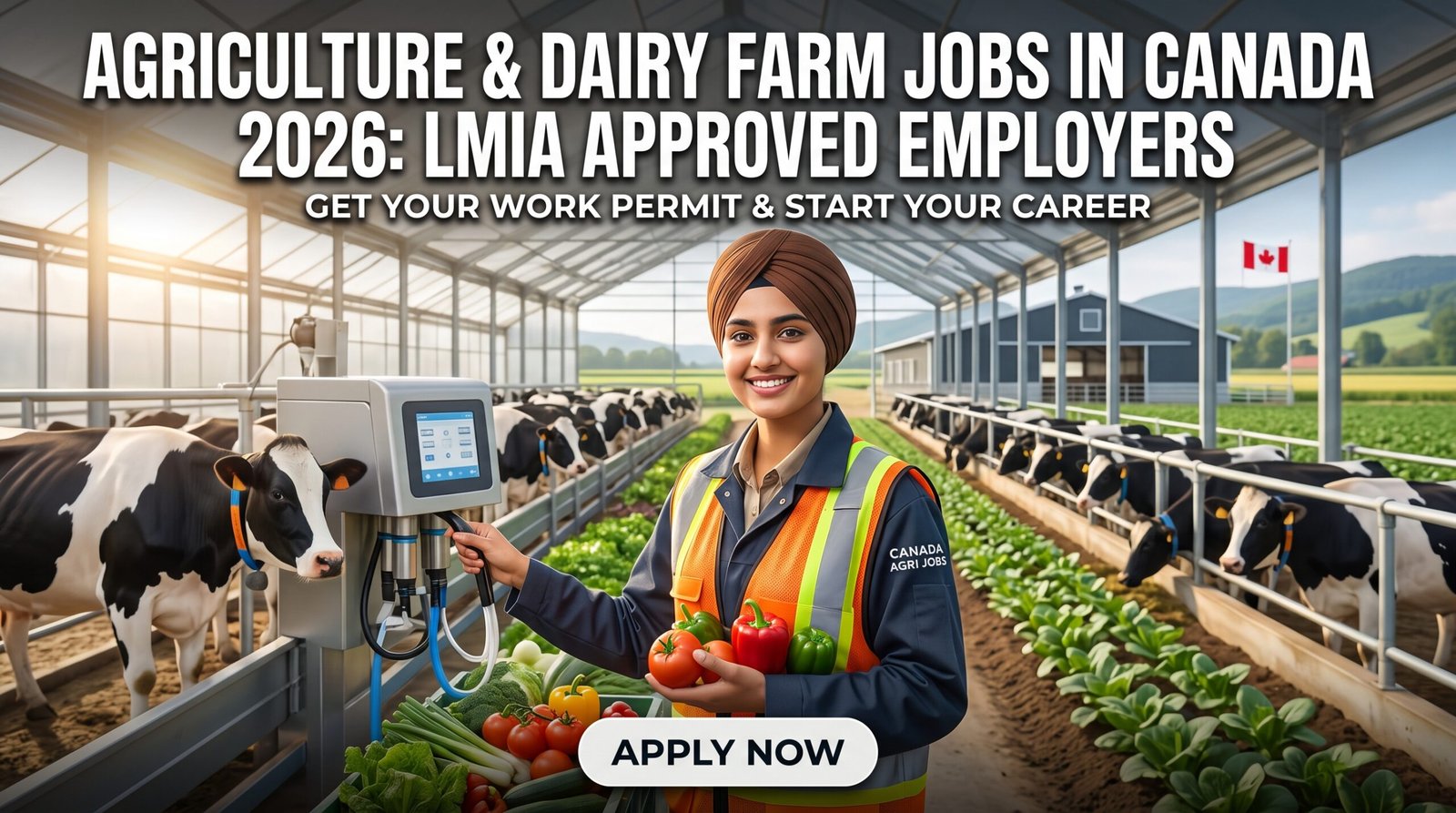
Agriculture & Dairy Farm Jobs In Canada 2026: LMIA Employers
Over $110 billion is added each year to the Canadian national GDP by Canada’s agricultural industry. But the country is grappling with a continuous shortage of manpower in farming, greenhouse cultivation and livestock farming. The Canadian government keeps turning to foreign labour to fill these areas of need. Interested in moving to North America to pursue a career in Agriculture or the dairy sector or are based there and looking for new opportunities, then Agriculture & Dairy Farm Jobs in Canada 2026 could be your best bet to realizing your dreams.
Many foreign nationals will need a Labour Market Impact Assessment (LMIA) to be able to obtain employment in Canada. The Canadian government grants Canadian Employment Market Opportunities to Canadian employers who were not able to hire a Canadian citizen or permanent resident to fill a job opening.
Why Canada is Hiring Foreign Agricultural Workers in 2026
Canada has extensive farmland, especially in its provinces of Ontario, British Columbia, Alberta and Saskatchewan, that yields some of the world’s most fertile farmland. The domestic workforce has however become aged and few young Canadians are opting for physically challenging jobs in rural areas.
The need for quality farm workers is more acute than ever in 2026. Farms demand constant attention; even animals need to be fed every day, crops need to be picked before they go rancid and, of course, paint work in greenhouses must be done all the time throughout the year. This fundamental need is why it’s a government policy to provide strong support for employers who want to employ people from outside the country.
What is an LMIA and Why is it Essential?
The term “LMIA” will continually come across your ears if you want to work in Canada. LMIA is an acronym for Labour Market Impact Assessment.
Any Canadian employer looking to hire an FLL must apply to ESDC for an LMIA. If you receive a “positive” (also known as a confirmation letter) LMIA, while it is currently a requirement for a job to be ” fachada,” in reality, it means that there is no Canadian applicant who is able to fill this position and that the employer has no choice but to hire a foreign worker.
Why is it important for you?
An employer-specific work permit cannot be applied for unless both a positive LMIA document and a job offer letter from the employer are obtained.
- Important Note on LMIA Costs: It is illegal under Canadian laws for an employer to ask a foreign based worker to pay the cost of the LMIA application! Employer will be responsible for any LMIA costs. You are a huge red flag being contacted by an agency or employer and asking to have your LMIA paid for.
Key Visa Pathways for Farm Workers in 2026
There are streams of immigration and work permits which are focused on agriculture. It’s important to understand which program you are an ideal fit for when applying to one of their programs.
The Temporary Foreign Worker Program (TFWP) – Primary Agriculture Stream
The TFWP is an option for Canadian employers to fill temporary labour and skills gaps. The “Primary Agriculture Stream” is specifically for jobs related to on-farm operations, such as planting, harvesting, and raising livestock. Employees under this stream may be allowed to come to Canada to work for a specific time limit and as per the contract (usually up to 2 years).
The Seasonal Agricultural Worker Program (SAWP)
The SAWP is an atypical stream according to the TFWP. It enables companies to bring in temporary foreign workers for up to 8 months annually, usually when work is in full swing on farms and in factories (between January to November).
- Note: SAWP access is limited to citizens of certain participating countries, such as Mexico and some Caribbean Islands. If you don’t have your country listed on the SAWP, you need to apply on the Agriculture Stream of the regular TFWP.
Alternative Permanent Residency (PR) Pathways
Despite the high demand, the Agri-Food Immigration Pilot is now closed for new applicants (with processing continuing to take place for current applicants in 2026), there are other pathways for agricultural workers to become Permanent Residents (PRs):
- Rural and Northern Immigration Pilot (RNIP) / RCIP: Other Permanent Residency (PR) channels.
- Provincial Nominee Programs (PNP): Country side such as Saskatchewan, Alberta and Manitoba have exact agricultural watercourses that are reserved for those with a valid job offer and on-the-ground work experience within the state.
- Atlantic Immigration Program (AIP): Farm workers who absence to live in Nova Scotia, New Brunswick, PEI or Newfoundland.
Types of Farm Jobs, Duties, and Salary Expectations
There are two things about agriculture that are diverse: that’s its industry and it’s its farmers. YOUR responsibilities, environment where you work and salary will depend upon the job you apply for on the farm. Here are the top agriculture and dairy farm employment opportunities that are expected to be relevant for Canada in the year 2026.
Agricultural workers complicated with increasing most produces are paid between CAD $17.60 to $25.00/hr or more per hour dependent on experience and province (wages are subject to provincial minimums – for 2026, some agricultural workers earn CAD $25.00 or extra per hour conditional on their experience and province).
Dairy Farm Worker
In some Canadian provinces such as Ontario, Quebec and Alberta dairy farming is huge. This is usually a position that doesn’t require seasonal hiring.
- Duties: Milking cows with automated milking systems; taking care of the animals’ food and water; cleaning stalls and barns; keeping an eye on the babies and adult cows’ health; work with farm machinery.
- Estimated Salary: CAD $18.00 – $26.00 per hour.
- Profile: Patience, physical strength and comfortable working with large animals are all a must for a profile. Early morning shifts (e.g., 4:00 AM) are very common.
General Farm Laborers
This is the most versatile role and requires little to no prior experience.
- Duties: Planting, growing and reaping crops. Using simple farm equipment; mending fences; scrubbing farm buildings; loading/ unloading farm produce.
- Estimated Salary: CAD $17.60 – $22.00 per hour.
- Profile: Its operators need to be ready for working outdoors during the hot summer months and rainy days.
Greenhouse and Nursery Worker
Indoor conservatories are essential to year round herbal and flower production in Canada, mostly in British Columbia and Ontario.
- Duties: Fixing seeds, transplanting sprouts, pruning plants, variable greenhouse temperatures and irrigation organizations, and selection ripe harvest (like tomatoes, cucumbers, and peppers).
- Estimated Salary: CAD $17.60 – $24.00 per hour.
- Profile: Outstanding for detail-oriented personalities. The environment is humid and warm year-round.
Livestock Assistant (Beef, Poultry, Swine)
Separately from dairy, Canada is a foremost producer of complaint, poultry, and venison.
- Duties: Breast-feeding animals, administering basic pills (under supervision), cleaning enclosures, bring together eggs (in poultry farms), and supporting in herding or affecting livestock.
- Estimated Salary: CAD $18.00 – $28.00 per hour.
- Profile: Former experience with animals is extremely chosen by employers.
Fruit and Vegetable Picker (Seasonal)
This is primarily a seasonal role secured to the SAWP or temporary harvest months.
- Duties: Hand-picking elusive fruits (apples, berries, cherries) and vegetables, sorting produce by value, and packing items into crates for transference.
- Estimated Salary: CAD $17.60 – $20.00 per hour (exactly farms offer piece-rate pay, meaning you grow paid per basket picked).
- Profile: Wants immense stamina, indirect, kneeling, and standup for up to 10–12 hours a day during peak produce.
Core Eligibility Requirements for Foreign Farm Workers
The agriculture sector does not typically demand a college diploma, but has a set of minimum qualifications to help keep workers safe and productive, which is prescribed by the Canadian government and employers.
- Age Requirement: Firstly, the age requirement is that you must be at least 18 years old at the time of your application for a Canadian work permit.
- Educational Background: None for general labour. Employers strongly prefer however a High School diploma and a Permanent Residency application is much easier after obtaining this.
- Physical Fitness & Health: Farming is indeed a very rigorous work. Lifting up to 50 lbs (22 kg) for extended periods of time, standing for long periods of time, and working outdoors in all weather conditions. You will also have to undergo a general Canadian Medical exam to ensure that you are not carrying communicable diseases.
- Language Skills: There are no restrictions on a candidate having good English and/or French. But it is strongly recommended that it’s done with a basic understanding (roughly equal to CLB 4 level), to understand safety instructions, to operate machinery properly, to communicate with supervisors.
- Clean Background: A police clearance certificate will be requested, demonstrating that you don’t have any criminal record in your country.
- Valid Passport: Your passport essential be valid for at least 6 months outside your proposed stay in Canada.
How to Find Legitimate LMIA Approved Employers
So, it does take some effort to find an employer that will sponsor your visa. Avoid agents on social media who guarantee you employment. Rather than turning to other channels, however:
- The Government of Canada Job Bank: This is the best and secure site. LMIAs are advertised by the employers who have already validly approved them. You can indeed narrow your job search by looking for “LMIA Approved” or “Canadians and International candidates.
- Direct Company Websites: International hiring is done by large agricultural companies on their own websites. Review job postings on sites of large regional or dairy farming co-ops, or large food companies such as Maple Leaf Foods, Highline Mushrooms.
- Provincial Job Portals: Check the Provincial Job Portals which may have promising agricultural recruiting opportunities (e.g., FARMS Ontario or the BC Agriculture Council).
- Verified Recruitment Agencies: If you are using an agency ensure that it is registered with the Immigration Consultants of Canada Regulatory Council (ICCRC). Keep in mind a legitimate agency will cost the employer to find talent, not the employee
Step-by-Step Guide: How to Apply for Farm Jobs in Canada
If you’re ready and qualify to achieve a dairy or ag job in 2026, do this step-by-step.
Step 1: Prepare a Canadian-Format Resume
Canadian employers imagine a specific restart format. It should be clean, concise (1-2 pages), and free of pointless personal specifics (no photos, no marital status, no conviction). Highlight any manual labor, undeveloped, construction, or machinery process experience.
Step 2: Search and Apply
Go to the Canadian Job Bank and key in farming positions such as “Dairy Farm Worker,” “Greenhouse Labourer,” or “General Farm Worker. Check Employer Postings that clearly list that they have an LMIA or are happy to apply for work authorization. Send your modified resume and a protection letter. .
Step 3: Ace the Virtual Interview
If shortlisted, the company will possible conduct a video conference via Zoom or WhatsApp. They want to evaluate your basic English/French, your understanding of hard physical labor, and your dependability. Be straightforward almost your experience.
Step 4: Receive the Job Offer and LMIA Document
On successful completion of the interview the employer will send you a formal Job Offer Letter in regards to the payment, working hours, housing etc. They’ll also send the positive LMIA document number to you.
Step 5: Apply for the Work Permit
Once you have proof of the Job Offer, LMIA, passport, medical and police, submit your application for an employer-specific work permit via the Immigration, Refugees and Citizenship Canada (IRCC) online application system.
Step 6: Travel to Canada
After you are granted your work permit and your visa is stamped you can make your flight to Canada. Some agricultural programs (in particular SAWP) cover or help pay for your round-trip airfare.
Expert Advice: How to Avoid LMIA Scams and Fraud
Unfortunately, the high request for Canadian visas has led to a substantial rise in immigration fraud. Defensive yourself is overriding. Here are the golden guidelines to sidestep being scammed:
- Never Pay for a Job Offer: It is banned in Canada to trade a job offer or an LMIA. If an “agent” enquires for $5,000 to “secure” your LMIA, it is a scam.
- Verify the Email Address: Real companies do not use @gmail.com or @yahoo.com email discourses for engagement. Check the province name.
- Look for the LMIA Number: A real LMIA file has a exact government-issued following number. You can confirm the employer’s acceptability through the Canadian government.
- Beware of “Guarantees”: No expert, lawyer, or manager can “100% guarantee” a visa agreement. Only an IRCC immigration captain has the authority to support a work certificate.
- Know Your Rights: Once in Canada, your employer cannot legally remove your passport or transport you for complaining about insecure work situations. You are safe beneath Canadian law.
Also Read : farm-worker-jobs-in-usa-with-h-2a-visa-2026/
FAQs
-
Can I bring my family to Canada on an agricultural work permit?
Generally, low-skilled agrarian work certifications (like SAWP or entry-level general labor) do not habitually allow you to transport your spouse and children. However, if you conversion to a permanent nationality pathway late, you can sponsor your family. High-skilled agricultural parts (like Farm Supervisors) may succeed for an open work document for spouses.
-
Do I need to take an IELTS test for a farm job?
For the temporary work permit, a recognized language assessment like IELTS is not stringently legally compulsory by the government, though employers want you to communicate safely. However, if you plan to relate for Permanent Residency later, you will requirement to pass a language test (minimum CLB 4).
-
Is the Agri-Food Immigration Pilot open in 2026?
As of early 2026, new consumptions for the specific Agri-Food Pilot are stopped, though existing applications are existence processed. However, workforces still have robust PR selections through Provincial Nominee Programs (PNP) and Rural Community Pilots (RCIP).
-
How long does it take to process the work permit?
Once you consume the positive LMIA and job offer, the work permit dispensation time varies depending on the Canadian delegation in your home country. On regular, it takes between 4 to 12 weeks.
-
What happens if I want to change employers in Canada?
Because you will be on an “employer-specific” (closed) work certification, you cannot only quit and work for extra farm. To change jobs, your different employer must apply for and accept a new LMIA, and you must relate for a new work permit formerly early work.
Final Thought
Make safe an Agriculture & Dairy Farm Job in Canada in 2026 with an LMIA-approved employer is a strange opportunity for thorough individuals looking to earn a constant income in a safe, planned environment. The Canadian government and isolated farm possessors rely seriously on international faculty to keep the nation’s food supply sequence thriving.
To prosper, focus on erection a strong, Canadian-style restart, applying straight through verified entrances like the Canada Job Bank, and making yourself for the physical veracities of farm labor. Most significantly, protect yourself from scams by thoughtful that legitimate employers will never responsibility you for a Labour Market Impact Taxation.
1 thought on “Agriculture & Dairy Farm Jobs In Canada 2026: LMIA Employers”