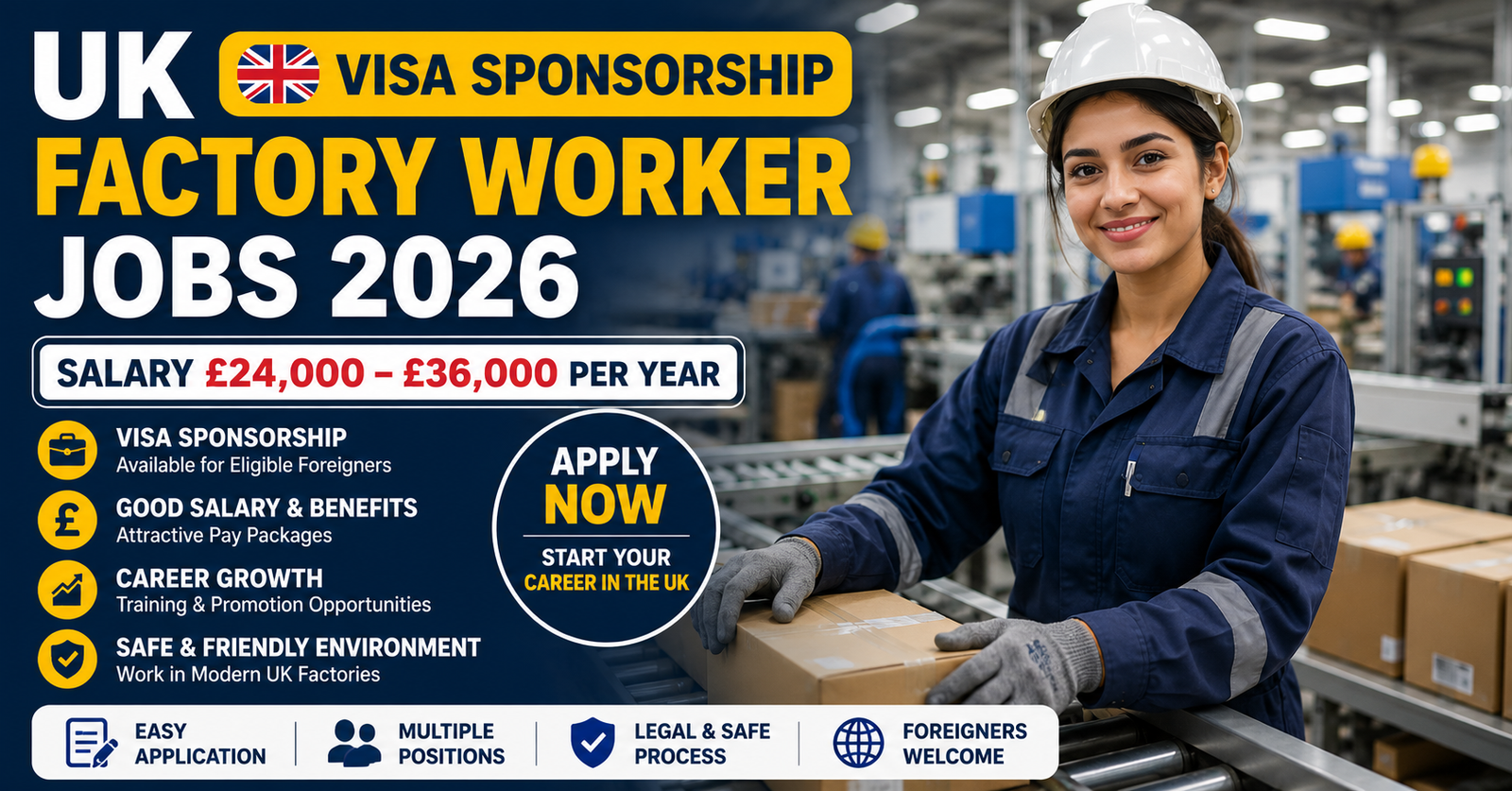
UK Factory Worker Visa Sponsorship Jobs 2026 | Salary & Apply Guide
Many overseas employment seekers have always envisioned a job in the United Kingdom and have thought about the high pay, fewer job restrictions, and job advancement probability. Due to the unprecedented circumstances, UK Factory Worker Visa Sponsorship Jobs 2026 for Foreigners are currently gaining relevance, as numerous factories and production units in diverse sectors are constantly seeking to hire workers to commit to manufacturing, packing, warehousing, and assembly. Some employers may sponsor a visa for a candidate, but the candidate must still meet the requirements of the employer seeking to hire him/her and follow the current immigration rules in the U.K.
UK factory operations span various sectors, such as food production, mining and quarrying, transport and storage, manufacturing of electrical and electronics components, motor vehicles, machinery, and vectors, as well as manufacturing of textiles and clothing and manufacturing of fabricated metal. There are also a number of jobs that will require less and less factory experience, or technical skills or experience in manufacturing. Successful candidates might be provided with on-the-job training to orient them to workplace processes, safety requirements and production requirements by their employer.
UK Factory Worker Jobs Overview
The key role factory workers play for the efficient functioning of the UK manufacturing industry. They help to manufacture products, use machinery, package goods, check the quality and motion the goods to distributors. Skilled and reliable employees are essential to a manufacturing company’s requirements as the people who will guarantee production goals are delivered and safety and quality are maintained.
There are many degrees of factory environments and their differences, and this depends on the industry in question. The food manufacturing plants emphasize hygiene and packaging, whereas the automotive factories deal with assembly lines, machines operation, and mounting parts. Some pharmaceutical facilities have to go through strict cleanliness procedures, while some factories based in warehouses may include inventory handling and preparation for delivery.
What Does a Factory Worker Do?
The jobs held by factory labourers are varied according to industrial process and industry; in fact, the scope of a factory’s operations ranges from the production of basic goods to the manufacture of raw materials. Officials’ task differs from factory to factory but for every product being produced the goal is to make it safe, economical, and to a required standard of quality.
Much of the work comes with the manipulation of production equipment and helping with manufacturing. The worker can also assemble products, oversee automatic machinery, package completed items or test them for defects prior to sending to the customers. There, workers in some factories may alternate jobs at production stations to keep the job moving and help them build up their “all-around” expertise.
Types of Factory Worker Jobs
The manufacturing business offers a wide choice of situations suited to different involvement levels and skill sets.
Production Operative
Construction operatives contribution with manufacturing goods, effective machinery, monitoring production outlines, and making complete goods for container.
Assembly Line Worker
Get-together workers shape or assemble produces using labor-intensive tools or automatic equipment while confirming constituents meet essential specifications.
Packing Operative
Packing workers package complete products, prepare batches, label goods, and confirm items are ready for shipping affording to company values.
Machine Operator
Machine machinists monitor industrial equipment, execute basic changes, identify mechanical issues, and preserve manufacture competence while following protection procedures.
Warehouse Factory Worker
These employees provision record management by getting materials, storing produces, preparing orders, and organizing consignments with logistics teams.
Quality Control Assistant
Quality regulator staff inspect goods throughout the industrial process, classify defects, and help ensure every item chances company excellence standards earlier leaving the factory.
Salary Expectations for Factory Workers in 2026
There is variation among the top-paying industries, locations, employers, shift work, experience and duties in terms of factory worker salaries in the United Kingdom.
Typical entry-level factory workers can earn a salary of from £24,000 to £28,000 a year, and the experienced worker or machine operators could be earning from between £30,000 and £36,000 per annum. There is some exception of specialised manufacturing occupations that can pay higher, based on technical skills and overtime hours.
Other advantages can be:
- Overtime pay
- Night shift allowances
- Weekend shift premiums
- Paid annual leave
- Pension contributions
- Employee discounts
- Performance bonuses
- Training programmes
- Career development opportunities
It is important for applicants to always do their due diligence to checking the official job announcement to ensure they have the latest information about the application’s salary and benefits since these may differ from employer to employer.
Skills Employers Look For
Employers in the manufacturing industry prefer skills and dependability over attitude. Demonstrating good workplace behaviours is a powerful asset to help gain employment, even for entry level jobs.
Some of the skills companies are looking for are:
- Good communication skills
- Teamwork and cooperation
- Attention to detail
- Time management
- Reliability and punctuality
- Comprehension of directions
- Simple number and letter skills.
- Safety awareness
- Problem-solving abilities
Previous experience around production machinery and/or in manufacturing is helpful but many employers offer well structured training around production machinery for suitable candidates with a positive attitude and willingness to learn.
Qualifications and Eligibility
Employers’ and manufacturing requirements determine qualification.
There are many entry level factory jobs based on the basic education level that is secondary education or its equivalent. Knowledge of manufacturing process can be helpful, but not always necessary to general production job.
- In addition, employers might ask applicants to take part in:
- Identity verification
- Right-to-work checks
- Employment reference checks
- For candidates who possess criminal records, conduct a background check.
- Developmental screening tests for some positions.
- Workplace safety training
Vocational qualifications, or experience of using technical equipment may be needed for some specialised manufacturing trade types such as the operation of technical equipment.
Working Environment and Shift Patterns
Get ready production demands, manufacturing facilities will likely be working around the clock. Therefore, work usually involves working shifts ranging from morning to afternoon to evening to night, weekends and public holidays.
There are differences in working conditions across industries. Engineering (automotive) works may include protective clothing, production machinery and assembly lines, and food production facilities will need to be slightly more clean. Jobs in the manufacturing industry in a warehouse may involve packing, moving and getting ready articles for delivering.
Industrial occupations tend to be physically demanding jobs, standing for extended periods of time, repeating jobs, or maneuvering materials safely. Employers must ensure that staff are trained regarding health and safety at work, and staff should pay attention to all procedures.
Benefits of Working as a Factory Worker in the UK
Those who work in the factories can secure a regular food supply and learn some skills in one of the largest employers of the UK. Manufacturing businesses are responsible for the creation of all types of products, including food and beverages, automotive components, electronics, pharmaceuticals and consumer products. Many of the employers work all year round and so they look for staff on a regular basis and offer a longer and formal induction process.
Besides a competitive pay, factory workers might also be given workers benefits, which may vary on the basis of the company as well as the contract. These benefits may be in the form of annual leave, pension contribution, overtime, shift allowance, assistance through employee assistance programmes, paid training, or career development assistance programmes. Some employers also provide attendance bonuses, employee discount, free food or transportation.
How to Apply for UK Factory Worker Visa Sponsorship Jobs
Locking a factory worker location requires careful training and a expert application. Employers often receive a large amount of applications, so giving your experiences and experience clearly can improve your probabilities of being shortlisted.
Step 1: Search Official Job Vacancies
Start by observing for vacancies on authorized company profession pages, recognized recruitment activities, or trustworthy UK job websites. Recited the job explanation carefully to understand the tasks, required educations, working days, salary, and whether visa sponsorship is available for qualified applicants.
Step 2: Prepare a Professional CV
Your CV must be simple, well-structured, and related to the position.
Include:
- Special profile
- Employment past
- Education
- Developed or warehouse experience
- Contraption operation services (if applicable)
- Language assistances
- Contact specifics
- Situations (if available)
Where likely, include assessable achievements instead of only entry duties.
For example:
- Overflowing more than 500 goods per shift while maintaining value standards.
- Assisted construction teams in conference daily industrial targets.
- Followed workstation safety procedures with an exceptional presence record.
Step 3: Write a Tailored Cover Letter
Although not all employer wants one, a cover letter agrees you to explain why you are interested in the role.
Mention:
- Your attention in manufacturing
- Relevant skill
- Facility to work shifts
- Teamwork assistances
- Inclination to learn
- Visa sponsorship chucks where appropriate
Keep the communication qualified, concise, and attentive on the employer’s needs.
Step 4: Complete the Online Application
Many UK managers use online conscription systems.
Before acquiescing your application:
- Checked spelling and parsing.
- Upload the correct documents.
- Review service days.
- Answer suitability demands honestly.
- Confirm all evidence is accurate.
If false information may prime to your application existence rejected.
Step 5: Prepare for the Interview
If accepted, you may be requested to attend an connected or face-to-face consultation.
Mutual interview focusses include:
- Preceding factory or warehouse experience
- Occupied safely
- Teamwork
- Handling repetitive tasks
- Shift flexibility
- Meeting manufacture marks
- Problem-solving
- Incentive for working in business
Use cases from previous employment to prove your skills anyplace possible.
Documents You May Need
Wants vary by employer, but claimants are usually asked to provide:
- Updated CV
- Protection Letter
- Valid Permit
- Educational Certificates
- Service References
- Identity Forms
- Right-to-Work Leaflets
- Visa Info (if applicable)
- Professional Documentations (where required)
- Background Check Data (if requested)
Confirm your documents are correct and up to date already applying.
Expert Tips to Improve Your Chances
Struggle for manufacturing occupations can vary contingent on location and manager. A strong application often proves reliability, consideration to detail, and a optimistic attitude.
To recover your chances:
- Make CVs specific to each job.
- Emphasized manufacturing/household experience.
- Discuss the importance of being reliable and on time.
- Available for flexible work schedule.
- Get information on employer beforehand.
- Consider including a list of typical interview questions and answers.
- “Dress for the job you want – not the job you have.”
- Be forthright with your eligibility for work and sponsorship.
- Practice English reading, listening and speaking skills as needed.
- Always obey the manufacturer’s directions.
It may be important to employers to have consistent employee who are hard-working and eager to learn.
Common Application Mistakes to Avoid
Many applicants decrease their probabilities by creation avoidable errors.
Sending the Same CV to Every Employer
Customise your CV to replicate the skills and involvement requested in individually vacancy.
Ignoring Essential Requirements
Read the job explanation carefully before smearing to ensure you chance the employer’s prospects.
Providing Incorrect Information
Permanently provide correct employment dates, qualifications, and contact information.
Overlooking Health and Safety
Business employers place significant importance on workplace safety. Mention any relevant training or experience you have fashionable following protection procedures.
Assuming Visa Sponsorship Is Guaranteed
Some managers may offer protection for eligible applicants, but it depends on business needs and UK settlement requirements. Always confirm sponsorship specifics through the allowed recruitment development.
Also Read : australia-aged-care-assistant-jobs-2026/
FAQs
-
Do all UK factory jobs offer visa sponsorship?
No. Some owners may sponsor qualified international interviewees, but protection depends on the company’s staffing needs, sponsorship licence, and present UK immigration wants.
-
Do I need previous factory experience?
Not always. Many entry-level creation roles afford on-the-job training. However, preceding experience in manufacturing, warehousing, logistics, or creation can support your application.
-
What is the average salary for factory workers in the UK?
Salaries vary by employer and site, but many factory workforces earn about £24,000 to £36,000 per year, with additional actively and shift budgets available in about roles.
-
Is English required?
Most employers imagine applicants to have necessary English statement skills to understand workplace directions, follow safety processes, and work successfully as part of a team.
-
Are factory jobs physically demanding?
Many manufacturing roles comprise standing for long episodes, repetitive responsibilities, or lifting materials. The somatic requirements vary dependent on the specific commerce and owner.
Final Thought
UK Factory Worker Visa Sponsorship Jobs 2026 for Foreigners endure to offer valuable employment chances for persons attentive in erection a career in the UK’s engineering industry. From food construction and logistics to locomotive and electronics business, factory workers play an imperative role in supporting creation, maintaining quality values, and ensuring efficient operations.
By developing applied workplace skills, maintaining a tough work ethic, and cutting each request to the specific role, you can recover your probabilities of acquiring employment in the UK’s manufacturing subdivision. Careful preparation, realistic opportunities, and continuous learning can benefit you build a satisfying lasting career.