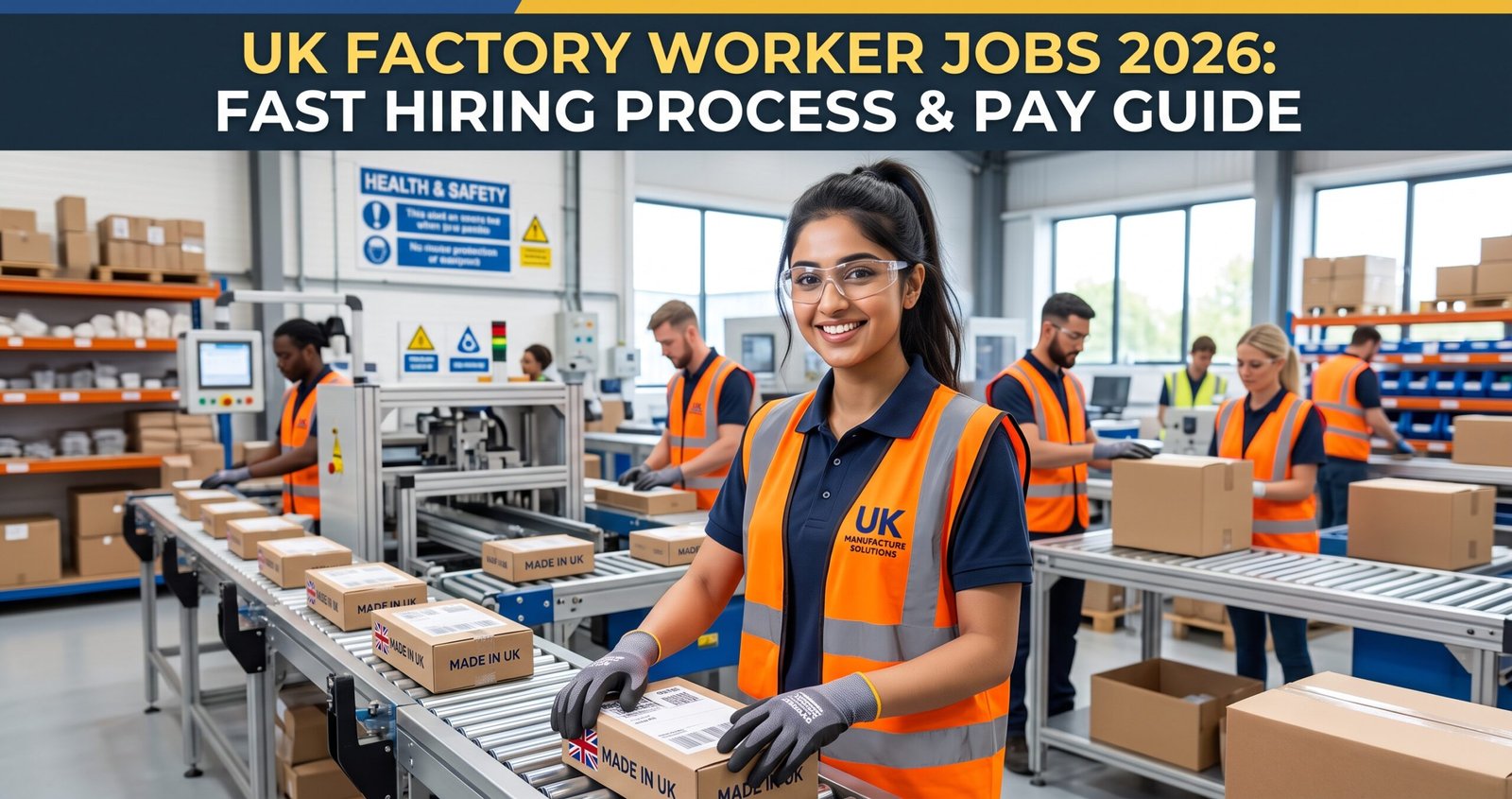
UK Factory Worker Jobs 2026: Fast Hiring Process & Pay Guide
Most people don’t have to spend years in school or through years in their jobs to find stable job that pays them well. From the north of England to Northern Ireland along with Wales and England, manufacturing plants, food processing centres and distribution hubs are actively looking for reliable workers to help maintain assembly lines and supply chains successfully. When venture into UK factory worker jobs in 2026, it’s important to comprehend the procedure of modern crew hire to decrease your contribution time and increase the chances of finding regular jobs.
Employment in manufacturing is easier and clearer than ever, with the support of numerous easy-to-use screening platforms, regional hiring intermediaries, and seamless hiring processes. But dealing with shift patterns, having an understanding of national living wage benchmark rates, avoiding online work ploys and ensuring that you have a right to work does not have to be daunting. From the local employers’ menu of positions, this book explains everything you need to know about your potential job, outlining the process of applying step-by-step and what to expect in the workplace to help you secure a stable career in the UK industrial sector.
Overview of the UK Manufacturing and Factory Landscape in 2026
The United Kingdom still has one of the world’s most resilient industrial sectors. British factories are trying to hire more people with the same consistency that fast-moving consumer goods (FMCG) require them, as well as those needed in the manufacturing of medicine, automotive and aerospace components. Despite the high rate of automation and robotics implementation in the production lines, there are still many areas were manual operation in handling machines has remained unchanged, such as processing quality audits, stocking raw materials, assembly and line dismantling.
True to the stereotype or false, the typical modern factory floor is very different to what is commonly perceived as a dark dangerous shop floor. By 2026, all industrial sites in the UK follow tight Health and Safety Executive (HSE) regulations, safety protocols, to maintain clean airflow and workstations. Thousands of production operatives are available on a monthly basis across the Midlands, Greater Manchester, West Yorkshire, in the North East and in the Central Belt of Scotland across hubs for business based on high tech.
Key Highlights: Pay Rates, Shifts, and Job Types
Before succumbing applications, it is important to understand representative compensation packages, active schedules, and contract types dominant across British industrial.
Baseline Compensation Benchmarks
Factory pay in the UK is anchored by the statutory National Living Wage, with substantial extras added for unsociable hours, stay work, and technical abilities:
| Role Level | Typical Hourly Rate | Typical Overtime Rate | Shift Types |
| General Assembly Operative | £11.80 – £13.00 | 1.25× to 1.5× base | Day shifts, central rotations |
| Food Production / Cleanroom | £11.80 – £13.50 | 1.25× to 1.5× base | Early morning (06:00), lates (14:00) |
| Night Shift Effective | £13.50 – £16.00 | Up to 2.0× on Bank Holidays | Static nights (22:00 – 06:00) |
| Forklift / MHE Driver (FLT) | £13.50 – £17.50 | 1.5× base | Revolving days/nights |
| Line Leader / QA Technician | £14.50 – £19.00 | Salaried / Quality hourly | Mixed managing plans |
Standard Shift Formats
- Rotational Shifts (3-Shift System): Alternating daily blocks between Earlies (06:00–14:00), Lates (14:00–22:00), and Nights (22:00–06:00).
- 4-on / 4-off: Employed 12-hour shifts for four successive days (or nights), charted by four consecutive rest days. This format offers important predictable rest time.
- Continental Patterns: Fast-rotating 8- or 12-hour shifts considered for round-the-clock manufacturing plant life.
- Fixed Day or Twilight Shifts: Ideal for parentages or students seeking predictable local hours without darkness variations.
Step-by-Step Guide: The Streamlined Hiring Process
All of this, and more, should not be a multi-step behavioral interview to secure factory restaurants. Employers value reliability, on time performance and a safe approach. Use this proven roadmap to get jobs fast:
Step 1: Register with Industrial Staffing Specialists
The big manufacturers have a central web for employment; however, about 70% of the eventual workers from factory jobs are recruited using a specialised recruitment agency. Sign up using a website with long-standing industrial suppliers serving them, like:
- Adecco UK & Randstad: Broad national links covering engineering, manufacturing, and container.
- Gi Group & Pertemps: Major providers for automotive and food production plants.
- Staffline & Blue Arrow: Marketplace leaders in high-volume food dispensation and e-commerce packaging deals.
Step 2: Prepare a Clear, Functional CV
Make your CV succinct, to no more than two pages. Industrial recruiters look for specific, practical information, not lengthy descriptions:
- Explain any experience in ‘hurry up and wait’ situations (stocking out in a busy retail store, preparing food in a kitchen, labouring).
- Specify what licenses you have, e.g. Counterbalance, Reach Truck, Bendi/Flexi forklift, Level 2 Food Hygiene or First Aid at Work certificates.
- Clearly participating in shifts: (e.g., “Immediate availability for Days, Nights and Weekends”
- Outline your journey to the workplace (e.g. “Full driving licence in the UK using private car”).
Step 3: Complete Identity and Right-to-Work Checks
Digital identity document validation technology (IDVT) is used by recruitment platforms. You will be provided with a secure link to your smartphone to send the information to include your passport or your biometric residence permit (BRP) and your live facial image. Against days of paperwork and to verification your eligibility in minutes.
Step 4: Undertake Workplace Safety Inductions
You are required to have a standard health and safety orientation before you start working on a production floor. Together, these are being offered by mobile learning applications by many agencies today. Topics cover:
- Proper Guide Handling Techniques (lifting with your legs, possession masses close).
- Personal Protecting Gear (PPE) regulations (steel toe-cap boots, ear protectors, high-vis vests).
- Hazard credentials, emergency removal routes, and the “Stop Line” practice.
Step 5: On-Site Walkthrough and First Shift
If you’re approved, your site walkthrough will be scheduled by the agency coordinator. You will have locker allocated, be informed of your Line supervisor and be allocated with an experienced “buddy” and your shift rota. Long-term contract extensions and direct hires are often dependent on displaying punctuality and attentiveness on first-day.
Eligibility, Legal Requirements, and the Reality of Work Visas
It is important to eliminate common recruitment myths internationally about taking on a job of lesser difficulty in factory work to retain full transparency and also safety standards of AdSense
Domestic and Settled Workers
Individuals who have legal rights to work in the UK can simply apply for positions in the factories right away. This includes:
- British and Irish nationals.
- As a result of the EU Settlement Scheme (EUSS), settled or pre-settled.
- Successful applicants of valid visas on which it is possible to work on a full-time basis (Youth Mobility Scheme, Graduate Visa, Partner/Spouse Visa and Ancestry Visa).
- International students who have visa restrictions that permit 20 hours per week work in term time and full time work at approved holiday periods.
Worker Benefits, Rights, and Statutory Protections
Prospective employees in the United Kingdom have among the strongest legal measures for workers protection in place when they start their employment, and factory workers in the UK (temporary and permanent employees) are granted many of the strongest employment rights in the world. If you are employed through an employment business or have a direct contract, you have the right to:
Statutory Paid Holiday
There is a legal right for all full time employees to take 5.6 weeks per year of paid leave, (28 days for 5 days a week) which can include bank holidays. Your holiday pay builds up on the basis of the hours worked in each year if you work on agency or variable hour days – this is usually calculated as 12.07% of your gross earnings.
Agency Workers Regulations (AWR)
The UK Agency Workers Guidelines give activity workers the correct to equal management after 12 weeks continuous provision with the same hirer in their intervention workers part. This includes exactly the same basic working/employment conditions (if applicable) such as access to the internal amenity facilities, rest breaks, identical pay rates and performance bonuses etc.
Auto-Enrolment Workplace Pensions
Your employer will automatically enrol you in your workplace pension if you are between the ages of 22 and the age you are entitled to receive state pension and making over £10,000 a year. You and your employer contribute toward your retirement accounts, then you will have a long-term financial security plan.
Expert Advice to Accelerate Your Placement
If you are looking to get noticed in a highly populated job search and make the switch from temporary jobs with agencies to full-time permanent factory work, consider these tips:
- Invest in Your Own Safety Boots Early: Safety boots that are comfortable and have composite foot steel with a cushioned insole are better investment in your feet’s safety, as agencies regularly provide basic PPE, but having specialized boots rather than those with steel toes can protect your feet when working in concrete as a standing job that lasts for 8 to 12 hours a day.
- Acquire Basic Certifications: Having Basic Certifications for counterbalance or reach forklift truck (RTITB or ITSSAR registered) certificate can instantly add £2.00 to £4.00 to your hourly rate. Food safety certificates (CIEH Level 2) also introduce you at the front of the line in the food manufacturing industry.
- Demonstrate Uncompromising Attendance: One worker on an automated production line can stop a complete production line. Frequent monitoring of attendance by factory managers. The 100% attendance of scheduled shifts over the first month is by far the best method of gaining a company permanent.
- Volunteer for Weekend and Overtime Rotations: The production managers will need cover every now and then for important export orders. Be flexible and go above and beyond what’s anticipated where it’s needed most – this can build goodwill and really help enhance your take-home pay.
Critical Mistakes and Scams to Avoid
Job seekers are at risk of common pitfalls and easy prey when there are lots of industrial job opportunities. Protect yourself: Do the following:
Paying Upfront “Application” or “Admin” Fees
Any recruitment agency that charges a employee for their job search will be breaking the law as per the Employment Agencies Act 1973 which is strictly against the law in the UK. Drop the recruiter if he asks for registration fees, document verification fees or compulsory medical fees.
Ignoring Repetitive Strain and Manual Handling Principles
Injuries can quickly curtail an industrial career. Always lift correctly, do not cut short. Always keep your back straight and bend your knees; carry cartons close to your chest, ask for a 2-person carry when carrying items
Relying on Unreliable Transit Routes
There are numerous large industrial parks and mega-fulfillment centres in rural areas on transport corridors like the M1, M6 or M4 main highways. Enlist the help of a map before accepting a placement, and make the route a route map in the early morning or late night hours. Keep buses on schedule at 05:00 during the morning shift(s) and 22:30 for evening shift(s) – failure of public transit to arrive at the right time will have a negative effect on your agency status.
Also Read : canada-visa-sponsorship-jobs-2026/
FAQs
-
Do I need prior experience to work as a UK factory operative?
No. The vast common of general container, line-feeding, and get-together effective positions are entry-level. Employers offer on-the-job training, standard effective procedure (SOP) instructions, and health and safety stimulations during your first modification. A positive attitude and straightforward communication services are all that is required.
-
How quickly can I start working once I apply?
If you consume your Right to Work forms ready (such as a valid passport or EUSS portion code) and are flexible concerning shift patterns, greatest industrial agencies can comprehensive your verification and residence you on a creation floor within three to seven days.
-
What is the difference between working through an agency and direct hiring?
Agencies hire you to effort on short-term, seasonal, or progressing contracts at client services. They handle your daily payroll. Direct hires are employed directly by the manufacturing company, regularly on annual salaries or eternal hourly contracts with paid sick consent and company perks. Many factories apply “temp-to-perm” pipelines, offering direct company contracts to top-performing support workers after 12 weeks.
-
Can international students take on factory roles?
Yes, providing the hours remain austerely within their visa limitations (typically a maximum of 20 hours per week throughout term time). Weekend day changes or twilight replacements are common selections for students balancing university study with extra income.
-
Will robots and automated machines replace factory workers?
While automation handles weighty, repetitive material transport, human misunderstanding remains vital crosswise British factories. Automation has shifted the environment of the work toward observing machines, clearing practical bottlenecks, conducting value audits, and managing sensitive creation packaging.
Final Thought
The UK industrial sector is still very much a mainstay in the economic stability of the country in 2026 with thousands of jobs available which are reliable and relatively easy to get. The adoption of new identity verification, fast-track recruitment and flexible agency placements in the factory have contributed towards making it one of the speediest routes to regular income in the contemporary British economy.
Concentrate on reliable agencies, cover your legal right to work paperwork, illustrate your reliability and Physical health. By improving its performance, with good attendance, it is not difficult to develop an entry level job as a worker in the factory into one of a specialist machine operator, a team leader or well-paid production line manager.
1 thought on “UK Factory Worker Jobs 2026: Fast Hiring Process & Pay Guide”