If you’re looking for jobs in food packing in the UK, there are jobs available in food factories, warehouses, food production facilities and seasonal agricultural businesses. These jobs usually involve preparing products for packing, checking food items, labeling boxes and keeping the work area clean. Some jobs require prior experience, others give basic training to new workers.
Applicants will need to know job requirements before applying by 2026. It is also worth checking whether the employer is willing to take on international applicants, and whether the role provides a legal route to work in the United Kingdom. Visa sponsorship not included by default for food packing vacancy.
This guide will explain the typical duties of a food packer, the main skills and qualifications you will need, how to apply for the job, how to write a CV and important things to consider before accepting a job offer.
What are Food Packing Jobs In UK ?
Food packing workers help to prepare food products for storage, transport and sale. They may work in factories, distribution centers, processing facilities, farms or other food production settings.
The products they handle may include fruit, vegetables, bakery items, meat products, frozen foods, ready meals and packaged snacks. The exact duties vary depending on the employer and the type of food being processed.
Some workplaces use automated packaging machines, while others require workers to pack items manually. Employees may stand for long periods, follow production targets and work in environments where temperature controls are necessary.
If you are comfortable with hands on work and following simple instructions, you might be a good candidate for the job in food packing. But the work can be physically demanding, and employers may expect workers to maintain a consistent pace and accuracy through a shift.
Food Packing Worker Common Duties
The responsibilities of a food packing worker depend on the workplace. Before applying, read the job description carefully to the understand what the employer expects.
Packing and Preparing Products
Workers may place food items into trays, bags, cartons or containers. They might arrange products on a conveyor belt and make sure each package contains the correct quantity.
Some jobs involve getting boxes ready to ship, separating different kinds of products or putting finished packages into the bigger boxes. Workers must follow the companys instructions to the avoid mistakes and the product damage.
Food Quality Control
Food packing employees may inspect products for the visible damage, incorrect packaging or other obvious problems. They may remove items not considered suitable and inform a supervisor if the they see a quality problem.
Workers should not ignore damaged packaging or products that do not look safe. They should follow workplace procedures and raise concerns with the responsible team member.
Labeling and Sealing Packaging
Another common task is the putting labels on packages. Labels can contain mandatory information such as the product names, batch information dates, etc.
Workers may also the seal containers, check that packaging is secure and verify that labels are placed properly. Accuracy is the important because mislabeling can create problems for the both the customer and the business.
Cleaning the Work Space
Food Production Environments Good hygiene practices are needed in Employees may need to clean work surfaces, remove waste, organize packaging materials and follow instructions for keeping a tidy workplace.
Depending on the job, workers may have to wear protective clothing, gloves, hair covering or other safety equipment. Training should include hygiene rules relevant to the specific job.
Production Team Collaboration
Food packagers often work with machine operators, quality control workers, warehouse workers and supervisors. They may be told about production targets, changes in packaging, and shift rosters.
Good communication prevents errors and smooths the way for a good production process.
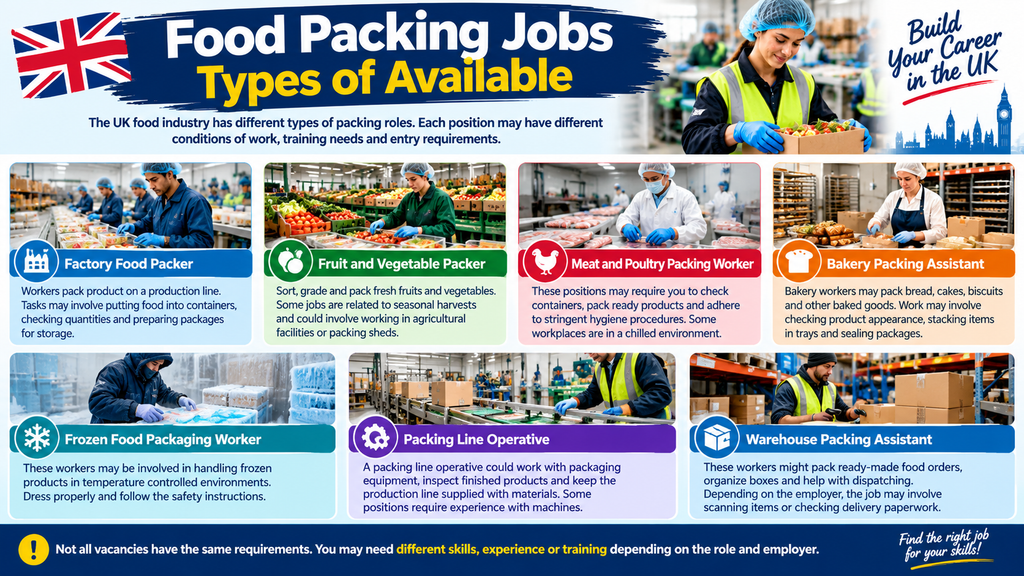
Food Packing Jobs Types of Available
The UK food industry has different types of packing roles. Each position may have different conditions of work, training needs and entry requirements.
- Factory food packer: Workers pack product on a production line. Tasks may involve putting food into containers, checking quantities and preparing packages for storage.
- Fruit and vegetable packer: Sort, grade and pack fresh fruits and vegetables. Some jobs are related to seasonal harvests and could involve working in agricultural facilities or packing sheds.
- Meat and poultry packing worker: These positions may require you to check containers, pack ready products and adhere to stringent hygiene procedures. Some workplaces are in a chilled environment.
- Bakery packing assistant: Bakery workers may pack bread, cakes, biscuits and other baked goods. Work may involve checking product appearance, stacking items in trays and sealing packages.
- Frozen food packaging worker: These workers may be involved in handling frozen products in temperature controlled environments. Dress properly and follow the safety instructions.
- Packing line operative: A packing line operative could work with packaging equipment, inspect finished products and keep the production line supplied with materials. Some positions require experience with machines.
- Warehouse packing assistant: These workers might pack ready-made food orders, organize boxes and help with dispatching. Depending on the employer, the job may involve scanning items or checking delivery paperwork.
Not all vacancies have the same requirements. You can’t tell from the job title alone if a position is right for your experience or immigration status.
Food Packing Job Qualification Criteria
Many entry-level food packing positions emphasize reliability, attention to detail and the ability to follow instructions. Some employers will take on applicants with no previous experience in a food factory, while others prefer those who have worked in production, packing or warehousing.
Employers may set the following requirements for applicants.
Communication and Basic Education
Some jobs do not need any formal qualification. However, applicants must be able to understand instructions in the work place, follow safety procedures and be able to communicate problems to supervisors.
Basic English can be useful at work, when instructions, labels and training materials are in English. The level required varies with the position.
Physical Fitness
Packing work can include standing for long periods, repetitive hand motions, bending and lifting boxes. Some jobs also involve transporting materials from one part of a production area to another.
Check out the physical requirements in the job description; Employers should explain any lifting limits and relevant safety arrangements at the workplace.
Knowledge of Food Hygiene
All workers must comply with the hygiene rules applicable to their role. Examples include proper handwashing, wearing appropriate protective clothing and reporting any potential contamination.
Some employers offer training after recruitment. Others may seek candidates who already have food hygiene or food production experience.
The Right to Work in the UK
You need to have the legal authority to do the job. If they already have the right to work, they may be able to apply to suitable employers directly.
If you are not a UK national please check the immigration requirements before accepting an offer. A job advertisement or informal promise by a recruiter is not authorization to work.
Are visa sponsorships available for international applicants for food packing jobs?
This is one of the key questions for the ones applying from outside the UK.
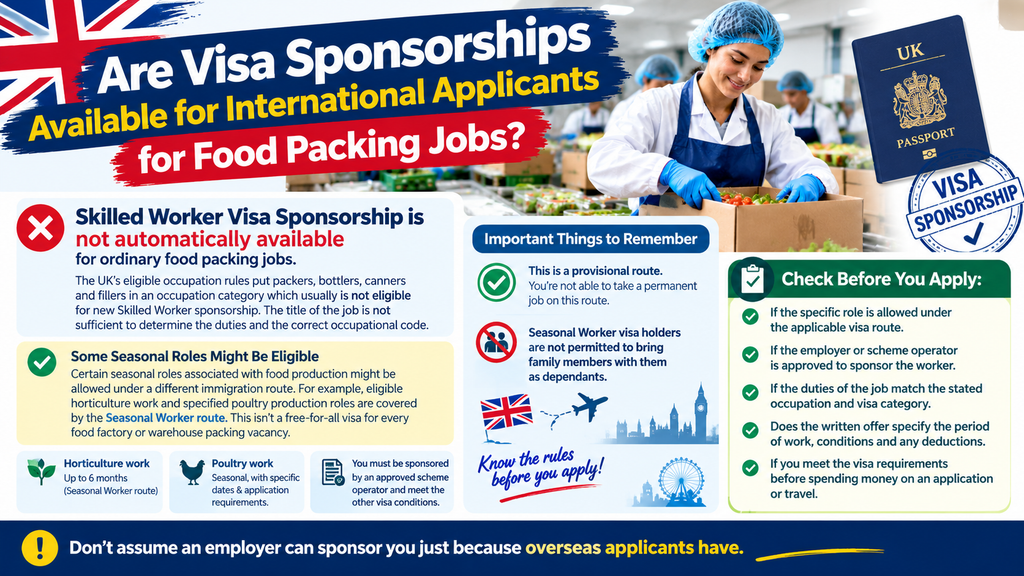
Skilled Worker visa sponsorship is not automatically available for ordinary food packing jobs. The UK’s eligible occupation rules put packers, bottlers, canners and fillers in an occupation category which usually is not eligible for new Skilled Worker sponsorship. The title of the job is not sufficient to determine the duties and the correct occupational code.
Certain seasonal roles associated with food production might be allowed under a different immigration route, but only in limited circumstances. For example, eligible horticulture work and specified poultry production roles are covered by the Seasonal Worker route. This isn’t a free-for-all visa for every food factory or warehouse packing vacancy.
Horticulture work under the Seasonal Worker route can be for up to six months. Poultry work is seasonal and has specific dates and application requirements. You must be sponsored by an approved scheme operator and meet the other conditions of the visa.
This is a provisional route. You’re not able to take a permanent job on this route. Seasonal Worker visa holders are not permitted to bring family members with them as dependants.
Check before you apply:
- If the specific role is allowed under the applicable visa route;
- If the employer or scheme operator is approved to sponsor the worker.
- If the duties of the job match the stated occupation and visa category.
- Does the written offer specify the period of work, conditions and any deductions.
- If you meet the visa requirements before spending money on an application or travel
Don’t assume an employer can sponsor you just because overseas applicants have been mentioned in the advertisement. Even if you have a job offer there is no guaranty you will get your visa approved.
How to Apply for Food Packing Jobs UK
A good application can help employers understand your experience and suitability. Go through a process and do not apply for all vacancies with the same application.
Step 1: Choose the Jobs That Fit You
First, decide what kind of work you want to do. You could enjoy food packing, sorting fresh produce, bakery packing, working on a production line or warehouse packing.
Are you able to work rotating shifts? Weekends? Early mornings? Some facilities operate 24 hours a day, 7 days a week. Seasonal businesses may have different working patterns.
Step 2: Hunt for Real Vacancies
Look for job opportunities on official employer career sites, recognized recruitment agencies and legitimate seasonal work scheme operators where applicable.
Read the full ad. See location, responsibilities, experience requirements, working hours and application method.
If you are applying from abroad, you should pay particular attention to whether the employer accepts international applicants and whether a lawful visa route applies to that particular role.
Step 3: Get Your CV Ready
Make your CV easy to read and relevant to the job. Please provide your contact details, a brief professional profile, work history, relevant skills and training.
If you have worked in a factory, warehouse, supermarket or a restaurant or any food business please describe the duties you carried out. Useful experience could include packing, checking stock, working to hygiene rules or achieving daily targets.
If you have no experience, emphasize transferable skills such as punctuality, teamwork, careful handling of products and willingness to learn.
Don’t list any qualifications or work experience you don’t have.
Step 4: Carefully Fill the Application Form
Follow the orders of the employer. Fill in the required fields, submit correct details and upload your CV in the required format.
Be honest if an employer asks you about your entitlement to work. If you have been issued one, do not pretend you have a visa or permission.
Check your contact details before you submit your application so the employer can contact you if you are short-listed.
Step 5: Interview Preparation
Some employers will set up a telephone or online interview. Others may call applicants in to an assessment or a workplace interview.
Be prepared to answer questions about your availability, previous experience, ability to follow hygiene rules and attitude to repetitive work. You may be asked how you would react if you saw a damaged package or a wrong label.
I’m trying to be honest and clear Ask about shift patterns, training, protective equipment and the main duties of the role.
Step 6: Look Over the Offer Before You Accept
Read the terms of employment before agreeing to work. Check the employer’s identity, where the workplace is, the hours expected, the pay arrangements and any lawful deductions.
If you need a visa to get the job, check the sponsor’s authorization and the immigration route that applies, on your own. Never give money to a recruiter on the promise of a guarantyd job or visa.
Keep a copy of the job advertisement, the written offer and any key correspondence relating to recruitment.
Also Read:Men’s Hairdresser Jobs in the UK 2026: Complete Application Guide
How To Write A Good Resume For Food Packing Job
You don’t have to make a complicated CV for an entry level packing job. It’s got to show you’re capable of doing the work and doing the jobs carefully.
Begin with a brief profile. For example:
I am a hard working and reliable applicant looking for a job in food packing. Able to follow instructions. Able to work as part of a team. Able to maintain an organized work place. Willing to learn the working procedures and perform the assigned duties carefully.
Simply use statements that are true for you.
In your Work History, write what you actually did, don’t just give job titles. For example, a person who used to work in a warehouse might tell you they packed orders, checked quantities and prepared goods for dispatch.
Add relevant training if you have done any. This may include training in food hygiene, workplace health and safety, manual handling or machinery. Don’t take certificates you haven’t earned.
Use good headings, check the spelling before you send your CV and keep the layout simple.
Common Errors to Avoid
One common mistake is to use without reading the requirements. This can be a waste of time and lead to applications for jobs that are not suitable for your experience or right to work.
Another misconception is that every food packing job offers visa sponsorship. There are lots of vacancies for people who already have permission to work in the UK.
Applicants should also be wary of offers involving unusually easy recruitment, guarantyd visas or immediate employment, in return for large advance payments. Before you send sensitive documents or pay real application fees, look at the employer and any associated sponsor.
Finally, don’t overstate your experience. Employers need to know accurately about your skills, availability and eligibility. Honest applications are the best basis for a successful recruitment process.
Jobs in Food Packing in UK: Essential Information
| Subject | What Applicants Need to Know |
| Typical duties | Packing, labeling, checking products and hygiene. |
| Experience | Some entry-level jobs offer training |
| Useful skills | Accuracy, team work, reliability and ability to follow instructions |
| Work setting | Factories, food processing plants, farms and warehouse |
| Work conditions | May require standing, repetitive tasks or cold environment. |
| Visa sponsorship | Not available for ordinary packing jobs, automatically. |
| Seasonal jobs | Only roles eligible under the relevant route qualify |
| Application papers | CV, contact details and any documents required |
| Prior to taking | Check employer, duties, written terms, right-to-work requirements |
Frequently Asked Questions
1. Is experience required for food packing jobs in the UK?
Not quite. Some employers hire entry level workers and train workers. Other roles may require previous experience in food production, packing or warehousing. Always check the requirements of the vacancy.
2. Can I apply for UK food packing jobs from Pakistan?
You can search for job vacancies and apply for jobs but whether you are allowed to work in the UK depends on your immigration status and whether there is a suitable legal route. You do not have the right to work just because you have an application or job offer.
3. Do UK food packing jobs provide visa sponsorship in 2026?
Standard food packing jobs would not normally qualify for the new Skilled Worker sponsorship. Under the Seasonal Worker route some specific seasonal roles can be permitted but the specific roles and sponsor must meet the applicable conditions.
4. Can I bring my spouse on a Seasonal Worker visa?
Nope. The Seasonal Worker visa does not allow the worker to bring family members with them as dependents. If you are moving with family you should consider a different immigration route and check the requirements.
5. What skills do you need for food packing jobs?
Useful skills include attention to detail, punctuality, teamwork, communication, hygiene awareness and the ability to follow instructions. Some positions may also require experience with warehouse systems or packing equipment.
6. What should I put on my CV?
Add your contact details, professional profile, relevant employment history, skills and real training or qualifications. Mention duties such as packing, checking products, hygiene, stock handling or production work if applicable.
7. How to prevent recruitment fraud?
Check the employer and recruitment organization independently. Be wary of promises of guarantyd visas, vague contracts and demands for large upfront payments. Use approved scheme operators for seasonal farm work Check their official recruitment arrangements.
Conclusion
Food packing jobs in the UK can offer opportunities for those who are interested in practical work in food production, packaging and warehousing. Some jobs are for beginners, some require a previous experience or specific skills at the workplace.
Well, to increase your chances, prepare a clear CV, read the vacancy details carefully and apply only for roles matching your background. If you are applying from outside the UK please check your right to work and the relevant immigration requirements before accepting an offer.
The first and most important step is to validate every opportunity. A genuine job offer will detail the work and employment conditions, and any alleged visa sponsorship should be verified through the correct official channels.
1 thought on “UK Food Packing Jobs 2026: Complete Guide”